Mysterious Object 1998 KY26 Near the Sun: Scientists Continue to Debate Its Origin
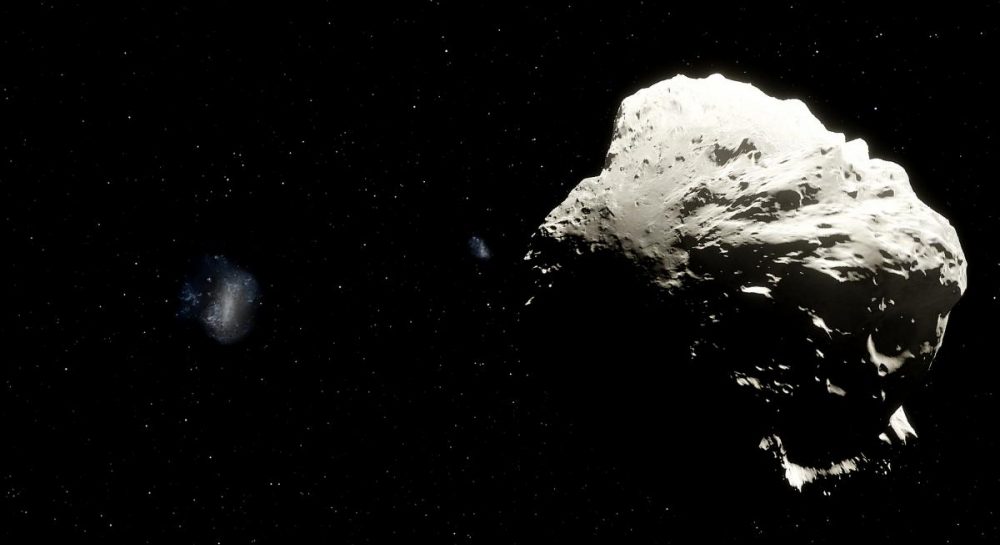
Astronomers have spent decades studying an unknown 11-meter celestial body orbiting the Sun with anomalous acceleration.
 🏙️City
Photo: UNIAN
Key points
- The 11-meter object 1998 KY26 orbits the Sun.
- Scientists have detected non-gravitational acceleration.
- Theories include an asteroid, a Soviet Phobos-1 probe, or a dark comet.
- The Japanese Hayabusa2 probe changed its destination due to engine issues.
For many years, the scientific community has been trying to unravel the nature of a mysterious object designated 1998 KY26, which measures about 11 meters in diameter. Initially, this space traveler was classified by researchers as a standard asteroid, but subsequent observations forced a reassessment of this assumption due to its unusual trajectory.
Origin Theories: From a Soviet Probe to a Comet
The main puzzle for astronomers has been the presence of so-called non-gravitational acceleration in the body. This means the object is influenced by forces other than regular gravity, which contradicts the behavior of typical rocky asteroids. Prominent Harvard astrophysicist Avi Loeb has put forward a bold hypothesis suggesting that 1998 KY26 is actually the lost Soviet unmanned spacecraft Phobos-1, launched in 1988 to study Mars.
At the same time, another popular theory suggests the object is a 'dark comet' that has lost its characteristic tail due to a lack of active ice sublimation. However, recent research published in the journal Icarus calls this version into question because the object's average surface temperature is too high, hovering around 11 degrees Celsius.
Cancelled Research Plans
Direct spacecraft exploration could have provided definitive answers regarding the origin of 1998 KY26. It was expected that Japan's Hayabusa2 probe would reach the object by 2031. However, due to engine issues, the Japan Aerospace Exploration Agency (JAXA) announced that the probe will instead head toward a different asteroid.
Source UNIAN — unian.ua/curiosities/asterojid-1998-ky26-obertayetsya-navkolo-soncy… ↗
Read next
 🚨Events
Air Assault Forces Deny Reports of New Border Breakthrough in Kursk Region
The Command of the Air Assault Forces has officially denied social media rumors regarding an alleged new breakthrough by Ukrainian forces and the capture of a settlement …
 🏛️Politics
Debate over NABU's methods: SAP prosecutor highlights the agency's media team
SAP prosecutor Rostyslav Batih addressed criticism regarding the substitution of evidence with media campaigns, praising the professionalism of NABU's video editors.
 ⚽Sport
ATP Finals Review: Carlos Alcaraz Dominance and the Next Generation Outlook
Sports commentators summarize the end-of-season ATP tournament, highlighting the triumph of Spanish tennis player Carlos Alcaraz and the success of young athletes.
 🩺Health
Scientists Identify Two Age Milestones When Human Immunity Ages the Fastest
A new study reveals that the human immune system does not age gradually, highlighting two sharp decline periods around age 40 and after 60.
 🧠AI Analysis
Artificial Intelligence on the Battlefield: How Ukrainian Ground Robots Move Toward Autonomy
Ukrainian developers of ground robotic systems are actively implementing artificial intelligence elements to minimize dependence on operators and communication.
 🎭Culture & Sport
Historical Field Discovery: How a Random Find Revealed Secrets of King Alfred
Archaeological mysteries sometimes emerge from routine fieldwork, such as the discovery of a medieval English monarch's jewel during plowing.